Pit report · October 14, 2026
Reading haul truck OEM from dump body shape in satellite imagery
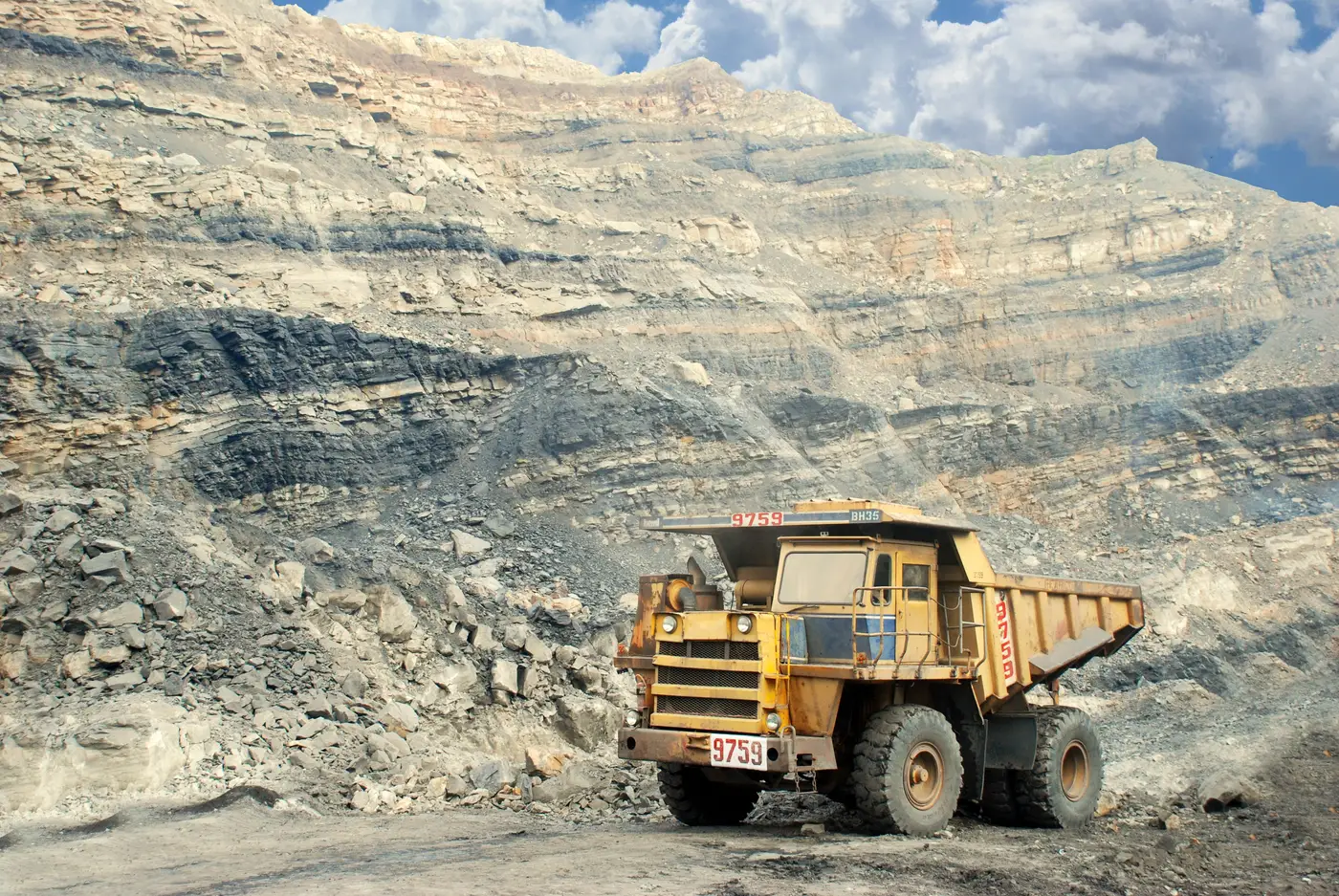
Rigid-frame haul trucks are the easiest vehicle class to pick out at a pit from above. They're the biggest moving object on the bench, they run the same haul road loop all day, and at VHR resolution each one throws a long, square-ish shadow you can measure off a single frame. Dump body shape and a handful of chassis cues identify which OEM built the truck, even without resolution fine enough to read a decal.
Start with tray proportions, not tray color
Paint fades, gets re-sprayed after a shop visit, and photographs differently depending on sun angle and season, so color is close to useless as an attribution cue from orbit. Proportions hold up better. Lay a tray's length against its width at nadir and you're already sorting trucks into rough OEM families. Komatsu's big electric-drive trucks, the 930E and 960E class, run a boxier tray with a nearly flat front wall. Liebherr's T 264 and T 284 carry a noticeably taller, more sloped front end that reads as a longer shadow on the cab side of the vehicle at low sun angle. Caterpillar's mechanical-drive line sits in between, and the forward canopy over the cab, the visor that protects the operator from rockfall, shows up as a small rectangular tab ahead of the main tray mass that isn't present in the same spot or size on every competitor's body.
None of this is a single decisive marker. It's a set of weak signals that stack. A pit running a known truck model mix gives you ground truth once, and after that the silhouette rules hold for the rest of that pit's fleet and for sister pits run by the same operator with the same procurement habits.
Rigid-frame vs everything else on the haul road
Before attempting OEM attribution, confirm you're actually looking at a rigid-frame haul truck and not a water truck, a lowboy, or an articulated dump truck working a smaller bench. Rigid-frame trucks have a short wheelbase relative to tray length, dual rear tires that read as a single wide dark band at VHR rather than two distinct circles, and they load at a shovel or excavator face rather than at a stockpile. Articulated trucks show a visible hinge point partway down the chassis and a narrower tray. A water truck carries a tank body that reads as a smooth, unbroken cylinder, with none of the flat panels and rib-line breaks a dump tray shows. Once you've filtered the haul road traffic down to rigid-frame units, the tray-shape heuristics above apply.
Counting this way, pit by pit, by hand gets unreliable fast once you're tracking more than a handful of sites a month. The truck count changes with the mine's production schedule, units get rotated between pits on the same lease, and a single pass doesn't tell you whether the fleet mix in front of you is the normal rotation or a one-off. That's the gap a monthly fleet count across every active pit is built to close, the same manufacturer-type tally run on a fixed cadence, so a shift in a competitor's fleet shows up as a line moving on a chart rather than a guess made off one clear day's imagery.
If you're sizing a competitor's installed base this way on your own, budget real time for the ground-truth step. Find at least one pit where you know the fleet mix from a press release or an OEM delivery announcement, confirm your silhouette rules against it, then extend the method to pits you have no other source on. Skipping that step and attributing OEM from tray shape alone, cold, on a pit you've never seen before, is where most manual counts fall apart.
If you want that cadence run across every pit you're tracking, that's the job Mine Fleet OEM Share was built to do.