Pit report · October 19, 2026
How to tell a rope shovel from a hydraulic excavator in satellite imagery
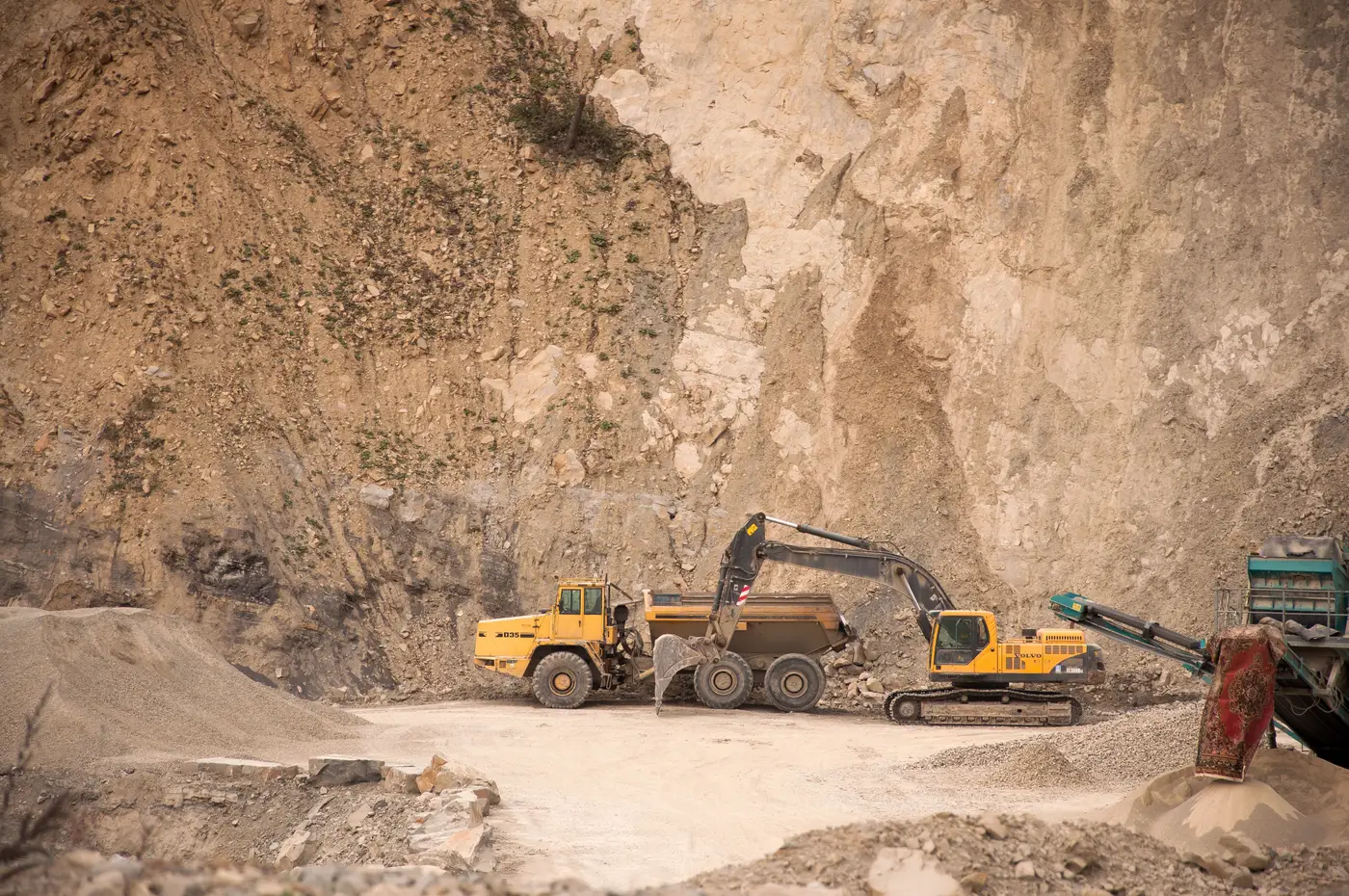
You can't read a nameplate from orbit, but you don't need to. A rope shovel and a mining-class hydraulic excavator have different skeletons, and at sub-meter resolution those skeletons show up as different shapes even in a single still frame. Here's what to look at before you start counting units pit by pit.
The boom is the tell
A rope shovel (cable shovel, in the older vocabulary) runs a single straight boom from the house to a point sheave, with a dipper handle that telescopes in and out through a crowd arm. From directly overhead, that reads as one long, uniform member, with the handle sitting roughly in line with the boom, thickening toward the bucket end during crowd. There's no elbow.
A hydraulic mining excavator, whether it's running as a backhoe or a front shovel, has a boom and a stick pinned together, and the stick articulates independently of the boom. That joint shows up as a visible kink, and because the stick angle changes with every dig cycle, two passes of the same machine can show two different arm shapes. If you're comparing a monthly image against last month's and the "boom" looks like it bent in a different place, you're looking at a hydraulic unit, not a rope shovel that happened to move.
Counterweight, house and the A-frame
Behind the boom, look at the back of the house. Rope shovels carry a mast or A-frame structure rising off the rear of the machinery house to anchor the hoist ropes, which on a clear VHR pass casts its own short shadow separate from the house shadow. Hydraulic excavators don't have this. Their counterweight sits low and flush against the rear of the house, usually read as a rounded or chamfered bulge rather than a raised frame.
House-to-crawler proportions help too. Rope shovels tend to run wide, squat crawler pads relative to house length, built for standing still and swinging a heavy load through a fixed arc. Big hydraulic excavators have a leaner footprint along the long axis, scaled to let the stick reach down into the dig face rather than relying purely on swing.
Shadow length and digging position
On a mid-morning pass with decent sun angle, shadow is doing half the identification work for you. A rope shovel's shadow is long and straight, tracking the fixed boom angle, because the boom-to-horizon angle on a cable machine stays in a narrow range regardless of where the dipper is in its cycle. A hydraulic excavator's shadow bends at the stick joint and changes length pass to pass depending on whether it's digging at bench level, below grade, or reaching up into a muck pile. If the shadow geometry on a unit shifts noticeably between two monthly captures and the machine hasn't moved pits, that's consistent with a hydraulic unit cycling through different dig positions, not a rope shovel.
Where this gets harder
Large hydraulic front shovels, the class built to mimic rope-shovel digging geometry, are the real confuser. They dig up and away from the machine like a cable shovel, and at a glance from above the boom can look nearly straight when the stick is fully crowded out. In those cases lean on the A-frame absence and the counterweight shape rather than boom angle alone, and cross-check against a prior pass of the same unit if one's available, since the stick kink will show up eventually across a time series even if one frame hides it.
Why this matters for a fleet count
None of this replaces a site survey, and nobody's reading a serial number off a satellite pass. But if the job is sizing a competitor's installed base by manufacturer type, pit by pit, without setting foot on their lease, getting the rope-shovel-versus-hydraulic call right on every major unit is most of the work. That's the premise behind a pit-by-pit roster of haul trucks, excavators and dozers by manufacturer type, updated on a monthly pass, tracked over time so the mix you logged this quarter can be checked against what shows up next.
If you're already doing this identification work by hand across a target's pit portfolio, it's worth seeing what a standing monthly count would save you.