Pit report · October 14, 2026
Rope shovel or hydraulic excavator: reading the digging unit from overhead
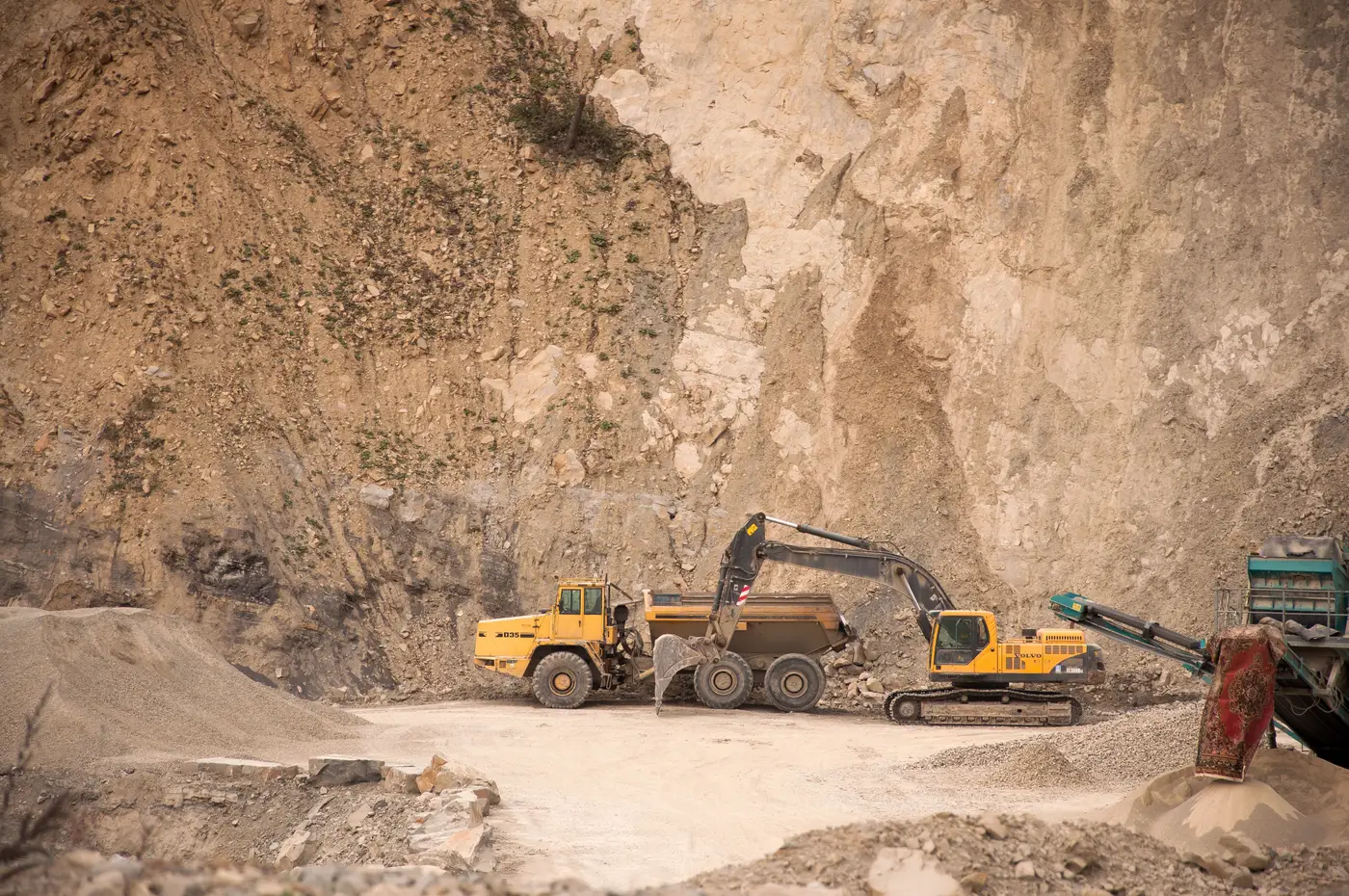
If you've ever zoomed into a pit image and tried to decide whether that digging unit is a cable shovel or a hydraulic excavator, you already know the paint scheme doesn't always help. Liveries get repainted, machines get sold secondhand between contractors, and at 0.5 m resolution you're not reading a logo off the counterweight anyway. What you're reading is shape, position and shadow. Here's what separates the two classes when you're working pit by pit.
Start with the boom, not the bucket
The single most reliable tell is the gantry. A rope shovel, the P&H and Komatsu-badged (formerly Bucyrus) machines you'll see in most large-scale opencut operations, has an A-frame or box-section mast standing up behind the boom, with wire ropes running down to the dipper handle. That mast throws a distinct shadow and gives the whole unit a taller, more vertical silhouette even when the boom itself is lowered.
A hydraulic excavator has no mast. The boom-stick-bucket arrangement moves on hydraulic cylinders, and from above you'll see a visible kink where the stick hinges off the boom. That elbow joint is the giveaway. Rope shovels don't articulate that way. The handle slides through a saddle block on a fixed boom, so the whole digging arm reads as one rigid line, angled but not bent.
Once you've trained your eye on that one feature, the rest of the classification gets faster.
Where it's parked tells you as much as what it looks like
Digging position is a second, independent signal, and it's useful precisely because it doesn't depend on image quality the way the boom shape does. Rope shovels work the toe of the bench, digging upward into the face and loading trucks spotted alongside at grade. You'll see the truck queue running parallel to the bench toe, tight and repetitive, pass after pass.
Hydraulic units split two ways. A face-shovel configuration digs above track level into the highwall, similar footprint to a rope shovel but with that bent-arm profile. A backhoe configuration digs below track level, which is how you'll usually find hydraulic excavators cleaning bench floors, pioneering new benches, or working low-wall cleanup where a rope shovel can't reach down. If the unit is sitting above the material it's moving rather than below it, that's a hydraulic backhoe, full stop. No rope shovel digs that way.
Track gauge and counterweight as a tonnage tell
The third check is proportion. Rope shovels in the large dipper classes carry a crawler gauge that looks disproportionately wide next to the house, because the machine needs that footprint to swing a loaded dipper without walking. The counterweight is also large and square relative to the house size.
Hydraulic excavators of equivalent tonnage carry a narrower track gauge and a counterweight that tapers rather than squares off. It's a subtler cue than the boom shape, but it's a good tiebreaker on a partly obscured unit, say one half-hidden by dust or parked close to a highwall that's throwing shadow across the dipper.
None of these checks work in isolation on every image. A dusty pass or a low sun angle can wash out the gantry shadow, and that's when the bench position and the track gauge earn their keep as backup evidence. Running all three together, boom geometry, dig position, undercarriage proportion, is what turns "there's a big shovel in pit 4" into a classification you'd put in a fleet count.
That's the exercise we run at scale: a pit-by-pit roster that classifies every digging unit by manufacturer type and tracks how the mix shifts month to month, so a rope shovel swapped for a hydraulic face shovel shows up as a line in the time series, not a guess. If you're sizing a competitor's fleet this way already, Mine Fleet OEM Share is built around exactly that count.
If you're trying to get a handle on how a competitor's pit-by-pit fleet mix is trending, that's the use case this site exists for.